





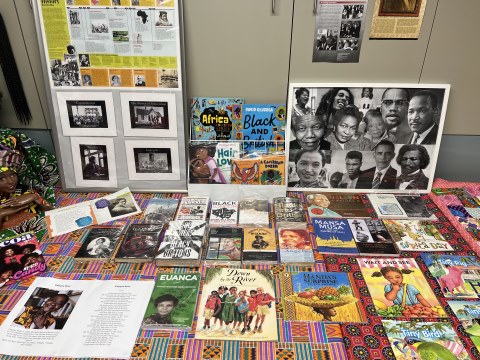
With October just being around the corner, many schools across the country are preparing to welcome and celebrate Black History Month, a time of reflection and remembrance, honouring the positive and profound contributions that Black people have made and continue to make to Britain.
But we are also reminded of the controversy that comes with teaching Black history in British schools, such as racism, inequality, slavery and colonialism.
I too was sceptical about the idea of teaching young children such a sensitive part of history in a single month-long period. I also questioned the fairness of dedicating an entire month to focus on the lives and experiences of a single race in such diverse schools across London.
Then there was the thought of Black history month being celebrated in the month of October, alongside Halloween’s ghost, ghouls and goblins! and with Halloween participation on the rise in the UK, October felt like an inappropriate time to honour the lives of our predecessors.
But more worryingly, I wasn’t entirely satisfied with Black history being taught in isolation, separated from the national school history curriculum and delivered as a stand-alone subject, as if it were not closely intertwined with British history and more generally world history.
However, my thoughts recently shifted after I delivered a Black history month workshop to primary school children in East London. It was then I realised just how important teaching children about the positive contributions that Black people have made to Britain are.
“Black people didn’t do as many good things in history as white people did” said an eight-year-old white boy, during one session. I wasn’t completely surprised nor was I prepared for the child’s awkward comment that reflected the current state in which history is taught in British schools and further exemplified the scale of work needed by teachers and parents to improve our teaching in lessons of the past.
But let’s not overlook the challenges that teachers face in raising the profile of Black history, exemplifying its worth and the meticulous skill required to teach such a sensitive fragment of history that is so closely intertwined with British history- the British Empire, slavery and colonialism, making it impossible to teach one without the other.
It was the former Labour leader Jeremy Corbyn, who hit the nail on the head when he called for Black history to be included in the national school curriculum. During a visit to Bristol, a city which grew wealthy on the back of the slave trade during the 18th century, Corbyn said: “Black history month should not be confined to a single month because Black history is British history.”
If we are to build a stronger, more unified and ‘post racial Britain’, it is essential that teachers, parents and those in prominent and influential roles adopt a similar attitude. It would enable future generations of school children to understand and appreciate the vast and positive role that Black people continuously make to British society.
The historian and broadcaster, David Olusoga, is also among those who have spoken out to defend the need to keep a month focused on Black history. “Teaching black history should be part of the school curriculum so that the uncomfortable parts of Britain’s story can be told,” he told ITV x.
When we examine present day injustices it becomes clearer to see just how important the story of Black Britain is told. From the Windrush scandal denying Black Britons their rights of citizenship to racial profiling consistent in police stop and search, to a bigoted white man calling an elderly Black woman an “ugly Black b****” on a passenger plane and to football hooligans imitating monkey noises at Black sportsmen, racism is everywhere, it’s pervasive and it’s dangerous.
Therefore, having a month-long commemoration dedicated to the lives, experiences and highlighting the positive contributions of Black people in Britain, just may be one way to challenge and eradicate systemic racism and to create greater awareness and understanding of a people and a history so often misrepresented or forgotten about.
And, until calls for full integration of Black history are listened to and are fully incorporated in the national school curriculum then yes, there remains every point in having a single month-long commemoration, to honour the Black men and women, who paved the way for future generations just like us.
Black History Month highlights the contribution of Britain’s high-profile figures in the arts and politics, as well as the lives of people like Stephen Lawrence, whose murder triggered nationwide soul-searching about institutional racism. Let’s continue remembering, continuing honouring and let us never forget our history.