


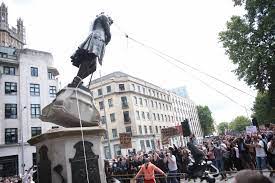
From as far afield as the South Africa Rhodes Must Fall movement to the former British slave ports of Bristol, symbols of colonial oppression have adorned and occupied public space for centuries.
But it was the pulling down of Bristol’s Edward Colston statue that really struck a chord with the British people, opening old wounds over slavery, colonialism and wide raging debates about why what history we remember matters.
Set on top of a 10ft plinth, the Edward Colston statue occupied a prominent location in central Bristol for over 125 years. His presence was grand yet vile. As Black Lives Matter protesters hauled the 8ft bronze statue to the ground and pursued it with kicks to the nearby harbour, cheers of adulation were loud and clear.
The removal had followed years on end of campaign and debate to have the controversial statue removed for its distasteful and stuffy undertones of colonialism and institutional racism.
For some critics the most distressing fact wasn’t that the statue was erected on a literal pedestal, on Colston avenue, In the shadow of Colston tower, on Colston street, and around the corner from Colston hall, but it was how the statue’s plaque described the oppressor as ‘One of the most virtuous and wise sons of the city.’
Surely, affixed plaques on statues and monuments should be honest representations, that reveal a truthful picture. This was not the case for Bristol’s Edward Colston statue
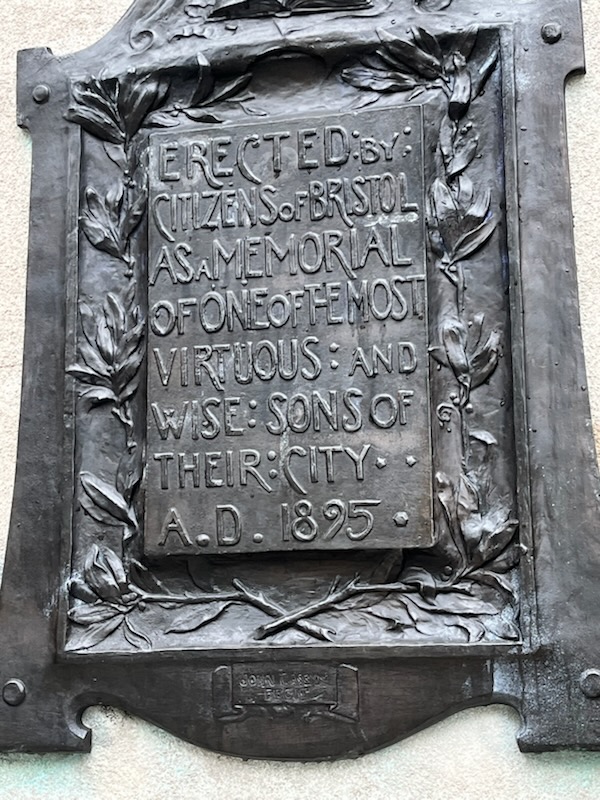
The astonishing attribution paid no reference to the appalling character Colston was. A more fitting inscription would have read something like this:
‘Edward Colston was one of the most evil and dishonest men of the city, an English slave trader, who in the most horrendous conditions, trafficked approximately 84,000 African men and women to the Americas, with an estimated 19, 000 dying on the journey. Under Colston’s watch, Africans were enslaved, murdered, raped, tortured, and exploited beyond extent. With slave labour profits paving the streets of Bristol with gold.’
For many years, Colston’s abysmal past had been largely hidden from the public. But in 1920, a reforming vicar named Henry Wilkins, first detailed the catastrophic Atlantic deeds of the slave owner in a critical biography. The book opened a can of worms as it detailed Colston’s leading role in the seventeenth century transatlantic slave-trade through the Royal Africa Company.
Colonial statues matter because all too often, statues and monuments occupying public spaces go unnoticed as we rarely stop to look, think or contest such fixtures.
And in the wake of Black Lives Matter protests, colonial statues have become a topic of heated discussion, outraging not only Black communities but people from all different backgrounds and walks of life. The permanent glorification posed by statues and monuments outwardly appear to celebrate white colonialist while forgetting the colonised, when they should rather serve as symbols of norms and values a nation agrees to commemorate, respect and be proud of.
The pulling down of Colston’s statue tells us that Historical monuments and statues occupying public space do matter to the public, particularly to the communities in which they are erected. They are like pieces to a jigsaw puzzle, creating mystery and sparking curiosity to historical events and stories. As one historian Professor Christopher Phelps said: “tributes, memorial are selective, affirmative representations and when a statue is erected of someone, it bestows honour and legitimacy.”
There needs open dialogue about colonial statues occupying public space. There is a cowardly unwillingness to acknowledge and come to terms with the fact that Britain is fundamentally built on a racist and uncomfortable past. Colonial statues are not benign and meaningless symbols but a constant reminder that Britain has yet to confront its colonial past, which makes them an issue of the present. And by failing to bring a critical eye to the colonial figures that overwhelm public space, it becomes abundantly clear as to which histories and people are valued.
Research conducted by historians recognise that many Black Britons do feel personally excluded by the public commemorative conventions of their country, with one Historian Madge Dresser asking: “If monuments are about remembering, who or what gets ‘forgotten’ in the public discourse? can be just as significant.”
A further interrogation into some of the issues that colonial statues pose is reflected in how they are perceived by Black British citizens as a site of psychological trauma. A similar view was expressed by students in South Africa, who fought long and hard for the colonial statue of Cecil Rhodes to be removed from the University of Cape Town, that stood as a constant reminder of the legacy of slavery, rape and massacre of their ancestors. And, confronting it on a near daily basis was expressed to be a ‘psychological site of trauma.’
The removal of Edward Colston’s statue has certainly challenged many facets of British History. A once benevolent image of the British Empire as a site of abolition, democracy, and multiculturalism has been thrown into disarray. A renewed consciousness of Britain’s connection with the transatlantic slave has changed the popular narrative to one of colonial dispossession and exclusion.
With a renewed understanding of what the statues that surround us stand for, let us continue to thrive, to question history and to continue to address how history is presented and transferred. For so many years the Edward Colston’s statue casted a shadow over Bristol, now it has gone, Bristol will become at much better place for correcting its history but also by creating a new, balanced and truthful history and future.